Chintan A. Trivedi

Senior Research Fellow · UCL · London

Chintan A. Trivedi, PhD

Interdisciplinary scientist researching how neural circuit development drives behaviour.

Engineer → neuroscientist → systems neurobiologist

My research asks how brain development shapes behaviour. To answer that, I build the hardware and software that run the experiments. These include microscopes, closed-loop behaviour systems and automated pipelines for imaging and for genotypic and phenotypic screening. I also write the code that connects them to instruments, data and the people who use them. My current work automates a Wellcome-funded zebrafish genetic screen, spanning robotic larval handling, spatial transcriptomics, functional imaging and behaviour. The screen lets me link the molecular profiles of neuronal cell types to their function, and ultimately to how those neurons shape behaviour.

Chintan Trivedi in the lab
Photo coming soon
Building instruments
Since 2007
Publications
13 · h-index 11
Wellcome grant
£4.5M, co-written
Students supervised
~20 at UCL

Systems I've built

Hardware · software · analysis

Automated genotype-to-phenotype screen

UCL · 2022 – present

VAST BioImager with a multi-well plate loaded
Photo coming soonVAST BioImager

A VAST BioImager loads larval zebrafish from well plates, orients them, images them and sorts them back into plates. I set up the robot and built its automated workflow from the vendor software's functions for the arm, valves and pumps. My pipeline keeps each larva's well identity from the source plate through imaging and back into the sorted plate. That identity and the fish's genotype then stay attached through every later step, from raw images to registered brains, processed data and the statistics behind the final figures, so any result can be traced back to the fish it came from. I also built the LIMS the screening team works in every day.

Robot
VAST BioImager: plate loading, orientation, imaging, sorting
Scale
46 genes screened, 11 with deep phenotyping, 1,000+ 3D brains imaged and analysed
Software
Python pipeline that keeps each larva's well and genotype identity from plate to final statistics; LIMS in daily use by a 5-person team
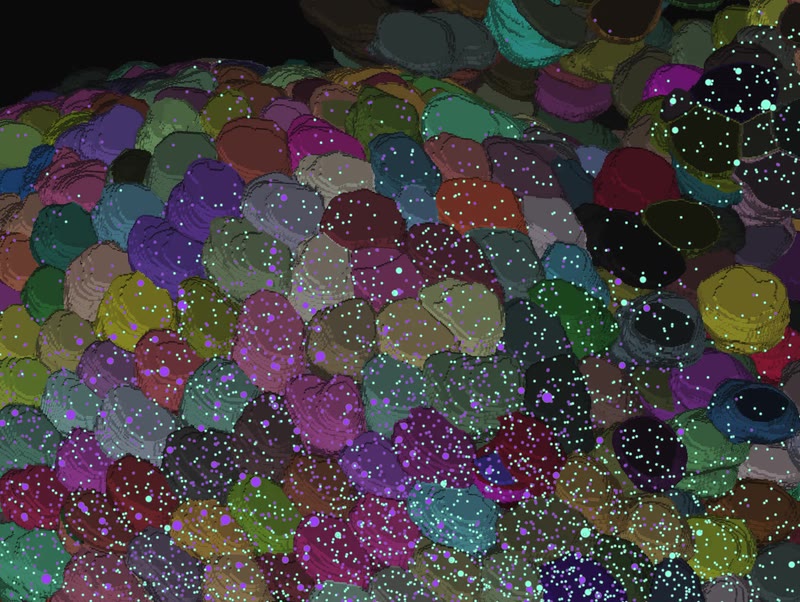
Zebrafish spatial transcriptomics

UCL In development

Segmented cells with single-molecule HCR transcripts
Movie coming soonSegmented cells and transcripts
3D model coming soonMicrofluidic staining chamber (FreeCAD)

An end-to-end system for mapping cell types in the larval brain: marker genes chosen from single-cell RNA-seq, HCR staining (in situ mRNA labelling) automated in microfluidic chambers I designed, single-molecule imaging and a pipeline from raw images to cell-type maps.

Markers
Derived from single-cell RNA-seq analysis
Staining
Automated HCR in custom FreeCAD-designed microfluidics
Imaging
Single-molecule HCR on a Zeiss Airyscan
Analysis
Working pipeline for cell segmentation, transcript counting and cell-type mapping

pybridizer: HCR probe design for any species

Open source · Python · PyPI

One probe pair 25 nt 25 nt 2 nt gap mRNA 1 · Tile 25+2+25 nt sites 2 · BLAST vs transcriptome 3 · Filter Tm and GC content 4 · Rank least off-target top-ranked pairs kept for ordering

Designs probe pairs for HCR v3.0 (hybridization chain reaction), which detects mRNA in situ in intact tissue with an amplified fluorescent signal. Probes are designed from a transcript sequence, with BLAST-based specificity checks against a custom database. That makes it usable on newly sequenced organisms that are missing from the standard databases. It has been used to design probes in mosquitoes, flies and zebrafish.

Validated in
The malaria vector Anopheles gambiae, STAR Protocols 2025 (~9 citations in its first year)
Used in
Drosophila: probes for labelling glia in a glial cell atlas (PLOS Biology 2023)
Zebrafish: HCR in the larval brain
Install
pip install pybridizer
Code
github.com/ctucl/pybridizer

Closed-loop virtual reality and two-photon imaging

Max Planck Institute for Medical Research · 2009 – 2016

Visual display virtual prey and scene Computer detects each swim and moves the scene Amplifier Larva EMG what the fish sees
Schematic · EMG-driven closed loop: each swim, read from muscle, moves the visual scene
IR laser pulsed Scanners x–y raster Detector PMT dichroic Objective Larva excitation fluorescence
Schematic · two-photon microscope, simplified light path

A virtual reality for larval zebrafish in which the fish's own swimming moves the visual world in real time. I built two versions: one driven by muscle (EMG) recordings and one driven by tail kinematics tracked in partially tethered larvae. Combined with two-photon imaging and single-cell patch clamp, it helped decode how visual processing in the brain, down to single neurons and synapses, lets the fish chain elementary motor patterns into a goal-directed prey-capture sequence. After I left, the system enabled the lab's discovery of a synaptic corollary discharge that suppresses midbrain visual processing during locomotion.

Built
VR driven by EMG or by tail tracking, two-photon microscopes
Recording
EMG, tail kinematics, single-cell patch clamp, calcium imaging
Papers
Frontiers in Neural Circuits 2013 (first author), Current Biology 2014 (equal first), Nature Communications 2023 (co-author)

High-speed behaviour rigs

UCL · 2016 – present

High-speed behaviour tracking rig
Photo coming soonHigh-speed behaviour rig
3D model coming soonChemotaxis and thermotaxis chamber (FreeCAD)

I set up the Wilson Lab's behaviour work from scratch: rigs, chambers and tracking. The rigs deliver multimodal stimuli (visual, acoustic, thermal and chemical) while a high-speed camera follows several larvae at once and tracks their behaviour in real time.

Tracking
Real-time, multi-larva, Python with numba
Stimuli
Visual (projector), acoustic (speaker), thermal (Peltier) and chemical (peristaltic pump)
Control
Every stimulus device driven from an Arduino or the PC; Arduino-based data acquisition
Hardware
Behaviour chambers of my own CAD design, including the one shown for chemotaxis and thermotaxis assays

Experience

Most recent first

  1. 2022 – present

    Senior Research Fellow

    Wilson Lab, University College London

    Co-wrote an 8-year, £4.5M Wellcome Trust grant with Stephen Wilson and Isaac Bianco, and was promoted after the award. Lead engineering for the lab's genetic screen, spatial transcriptomics and behaviour rigs, which I keep running and upgrade as experiments need.

  2. 2016 – 2022

    Postdoctoral Research Fellow

    Wilson Lab, University College London

    Established the lab's behaviour work and its automated, high-throughput image analysis from scratch.

  3. 2009 – 2016

    Doctoral Researcher, then Postdoctoral Scholar

    Max Planck Institute for Medical Research, Heidelberg

    Built closed-loop virtual reality and two-photon imaging systems to study how larval zebrafish turn what they see into goal-directed hunting. PhD (Dr. rer. nat., summa cum laude), University of Heidelberg, 2014.

  4. 2007 – 2009

    Research Assistant

    Texas A&M University

    MSc Biomedical Engineering. Built a time-resolved fluorescence spectroscopy system with automated, on-line analysis.

Selected publications

All 13 publications on Google Scholar

Toolkit

  • Programming
    Python (scientific stack), LabVIEW, MATLAB
  • Lab automation
    Instrument integration, LIMS design, automated imaging pipelines, microfluidics
  • Analysis
    High-throughput 3D image analysis (brain registration, cell segmentation, transcript counting); spatial and single-cell transcriptomics (marker selection, cell-type mapping); calcium imaging and electrophysiology; behaviour tracking and swim kinematics; end-to-end pipelines for multimodal, high-dimensional data analysis (PCA, ICA, CCA and related methods)
  • Instrumentation
    Optical and microscope design, electronics, electrophysiology (patch clamp, EMG), Arduino control and data acquisition
  • CAD
    FreeCAD, including the Optics Workbench
  • Teaching
    About 20 BSc and MSc research students supervised at UCL; PhD thesis committee member

Get in touch

Happy to talk about instrumentation, lab automation or AI in the lab.

c.trivedi@ucl.ac.uk